I’ve been thinking a lot more about online privacy for the last couple of years, so I was already prepared for the current controversy over Facebook’s change in its Terms of Service, and it wasn’t much of a shock to me. I’ve never really posted pictures there, imported my own blog posts, or posted links to anything that wasn’t already public somewhere else, because their Terms of Service always said they owned it and could do whatever they wanted with it. Even though they seem to be backing off and reverting to the previous TOS, I hope everyone realizes that nothing has really changed because they can implement the same thing in the future at the drop of a hat.
One of the biggest questions that should come out of this is do you want Facebook (and other social networks) to manage your online identity for you and your children? Just as you should be taking responsibility to shred your credit card receipts, checking on your credit reports, etc. to manage your “real world” identity, you should also think through how you manage your online identity, because ignoring the problem and just not having an online identity can actually backfire on you. Does everyone have to blog? Heck no, but there are smaller steps you can take.
I first started taking my online identity more seriously after reading an article titled Say Anything in New York magazine three years ago. I still find it fascinating, and I’ve come to appreciate it even more after having a couple of privacy incidents occur in my own life.
The first incident caused me to backtrack on privacy and limit access to many of my accounts to just friends and family, taking a more traditional approach to the issue. I felt like I needed to shut down open access to my life in order to preserve my identity, so I also cut back on the number of people I friended and became a lot more selective. I became like the father in the New York article, wondering why I would ever make those things public.
During the second incident, however, it turned out to be very fortunate for me that I already had a well-known identity online. In that respect I’m especially lucky I started early because I don’t have a very unique name, “Jenny Levine,” made worse by the fact that I now share that online namespace with an actress.
Now I completely understand the view of the teenager in the article, that it’s better to control your own identity than to let someone else create one for you. I still keep Facebook separate and limited to friends, and I still post most personal pictures for friends and family only, but everything else I share is available publicly because it helps maintain my identity online. It also means I don’t have to struggle as much with who can see what, and how much, and should I friend them back, and all of the other questions that come with participating in social networks.
I think the issue of having some sort of public, online identity will become even more important in the future as kids grow up with digital dossiers that – in many cases – their parents have created for them since birth. In fact, I think we’re going to see a trend in which savvy, educated parents give their children strange(r), unique names so that they can easily register a domain name for them. That way, even a minor presence like a blog or lifestream will always come up as the first result when someone searches for the kid, either to combat false information or provide a positive image (eg, to a potential employer).
As the child grows up, s/he can take over the online presence and populate it him/herself, but at least it’s already established so that someone else can’t fake one. Who knows how long we’ll use domain names, but I think this will be an issue for at least the next decade, whatever form it takes, and I fully expect to see a rise in identity bullying.
Iris Jastram has written a great post titled Facebook’s Devilish Contract, explaining her internal debate over what to do about her presence on social networks. I particularly love her use of the term the “social time out chair,” which is where you put yourself if you don’t maintain a presence on these sites.
As she notes, it’s not really an option for many people to opt out of social networks altogether. Better to post things to your own site and participate at a level you’re comfortable with, because I can tell you from experience that it could actually hurt your identity and reputation if your response to these issues is to just ignore them or take your ball and go home. Even if you quit Facebook, you have to be vigilant elsewhere. On the internet, no one knows you’re a dog, but they also don’t know that you’re you, and at this stage of the game, anyone can be you.
February 18, 2009
Who Is Managing Your Online Identity?
February 16, 2009
Thomas Frey at TSCPL #staffday
Library of the Future:Nerve Center of the Community – Thomas Frey, Senior Futurist at The DaVinci Institute, presented at the Topeka Shawnee County Public Library
we spend most of our time thinking about the past
– we know about it and have experienced it
but we’re going to spend the rest of our lives in the future
it’s like we’re walking backwards into the future
epiphanies are one of the things that separate humans from animals
every great new business is an epiphany
Frey had “a full category 5 epiphany”
“the life of an idea junkie”
Frey described a time he and his wife were sitting in a sidewalk cafe when he heard a song and used “Shazam” on his phone to find out the name of a song, which he then immediately downloaded
realized that his phone has a camera, too
the future of retail – when you see someone wearing a jacket you like, just take a picture of it to purchase it (just point and click at it)
in the future, all of our body info will be scanned in so that clothes fit the first time
no longer restricted to just what’s in stores
instead of owning a store, owners could hire models to walk up and down the street (not just clothing, but small appliances, too)
any product, anywhere, anytime
showed a slideshow of modern libraries
what form of payment will you put in a vending machine in 2059?
Frey thinks the vending machine of the future will be mobile and will come to you
will know what you want
might even fly
what music that we listen to today, will people still be listening to 100 years from now in 2109?
more importantly, how will we be listening to music 100 years from now?
will it just appear in our heads? will it still come from speakers?
the ultimate music player will have the ability to assess our reaction to the music and will only serve up music tha we react positively to
ultimate drink dispenser will have the ability to assess what kind of liquids our body needs and will only serve up a liquid that we react positively to
knows exactly how much sugar or cream should go in your coffee
the idea of “perfect water”
we all know polluted water is bad for us
if we take everything out of it, it’s less than optimal
somewhere in between is perfect water for each person in the world (6 billion different combinations)
somewhere in this line of thinking is the interface of the future
system thinking
no famous Roman mathemticians – they weren’t famous because they used Roman Numerals, which was a stupid number system
every number was an equation, which prevented them from doing any higher math with numerals
– no placeholder numbers
–> what systems are we employing today that are the equivalent of Roman Numberals?
– Dewey Decimal System, income tax code, “quart of oil”
is there a better system we could be using? invariably there is
Rick Wakeman video, keyboard player for the rock band Yes
he writes music with 64th and 128th notes
the piece he played in the video could never have been played on a traditional piano – needed a modern keyboard
Frey took a class about how to use a slide rule because he was told he had to
end of the slide rule era, beginning of the calculator era
he named the space between the bottom intersection the “Maximum Freud”
a time of lots of chaos but also of lots of opportunity
what technologies are at Maximum Freud anymore?
– fax machines
– checks
– keyboards
– computer monitors and hardware
– traditional television
– sign language
– invasive surgery
– AM/FM radio
– drill & fill dentistry
– the end of wires (telephone lines, cable TV lines, internet lines, and even power lines – within our lifetime)
the evolution of books
in what year will the last printed book be published?
Gutenberg Press – by 1500, there were more than 5,000 books in print across Europe
through the Espresso Book Machine
something like the Kindle may be as cheap as $5 in 5 years
at what point, is it too expensive for libraries to circulate print books?
when do ebook readers become so ubiquitous that it no longer makes sense to print ink on paper?
when does publishing become downloading titles
small projectors built into devices
information displays built into things
what does a book look like in the future?
every forum now is akin to an online forum, with authors, experts and other readers available to discuss and answer questions on almost every important book ever written
books are now conversations?
10 Global Trends
—————-
1. more people live in urban areas than rural areas (200,000 people a day migrate)
2. 840 million people crossed national borders, more mobile society (as opposed to 50 million in 1950)
3. number of new product launches (300 per day)
4. 550,000 new businesses were launched every month in 2007
5. more than 50% of all women reported being single in 2005
– more than 50% increase in the number of people living alone in the last 20 years
– counter trend of parents living with adult children – grew 67%
6. the number of people working through retirement has doubled
7. minorities will become the majority in 2042 (30% Latinos, 15% Blacks, 9% Asian)
– interracial families, 1000% increase in the past 30 years
– will stop talking about races in the future because they’ll be so undefined
– rises in the percentage of populations that are foreign-born
8. smaller families, bigger houses (700 sq. ft. in 1900)
9. coming boom in data centers (will consume 3% of global electricity supply by 2010; sometime before 2020 power consumption will double)
10. only 14% of all college graduates live in the U.S.
how long will it be before people can get a Ph.D without being literate?
the first time Frey listened to an audiobook, he thought he was cheating
reading is the process of translating the characters (text) on the page
still do it with sound when listening to books
method doesn’t really matter – it still counts
Socrates was not literate – never wrote anything
wouldn’t know anything about him if Plato hadn’t written about him
is reading the ultimate information experience?
are books a technology equivalent to roman numerals?
future of education
——————
did an 18-month study on this topic
organically generated content (courses) going to a global distributed system
an iTunes-like approach to education
teaching requires experts
we can’t train experts fast enough as information expands exponentially
teachers become a chokepoint
overlay a trend line of courses over YouTube, Wikipedia, and Google, it’s flat versus the amount of information being generated – courseware vacuum
MIT OpenCourseWare (1,400 courses) trying to fill that gap
– 12 universities have joined the OpenCourseWare Consotrium (1,800 courses total available)
what is the most important thing I should be learning today?
kids today aren’t being taught what they want to learn
what’s the primary inflection point for change?
– specially architected rapid courseware building, which doesn’t exist yet
12 dimensions of the future courseware architecture
————————————————–
60-minute learning units
modality and language agnostic (not just computer-based, get credit for experience); courses from everywhere but managed online
smart profiler & recommendation engine (what person is most interested in and what they should take next)
truth & accuracy – a high percentage of what’s being taught in classroom today is theoretical; every aspect of society has its own version of the truth
– need a truth authority? won’t work
– need a checks & balances system where any group could put their stamp of approval or disapproval on these courses
certification inputs – early adopters for this will be professional associations (what constitutes sufficient learning); home schoolers will also adopt this
official record-keeping system
global distribution system
available on demand 24/7, anytime, anywhere
less dependent on teachers and schools, more individual control
general study courses will be priced at $1/course
many schools will use these courses to plan their curricula
teachers will go freelance to create their own courses
students who graduate from the equivalent of high school in the future will be 10 times smarter than students today
the idea of taking K-12 education in one year, which will give rise to celebrity teachers
we’ll know when we get the right system put in place because a million new courses will be created
libraries will become the working laboratories for the creation of innovative new courses
libraries are central to his vision
commodity level – Starbucks
product level – a cup of coffee
experience level is what they concentrate on, though
how do we create the ultimate information experience in libraries?
people are using their own PageRank testing to figure out how relevant the library is to them individually
library as place, as opposed to library as service
———————————————-
building is a gathering place
8 reccs for libraries of the future
——————————–
to improve relevance in the minds of the community
1. create a search command center in your library; make it easy to people find information
– can look like a lot of different things, but have to help them conduct searches
– really only doing text searching right now, but need to prepare for other search attributes beyond just audio and video (taste, smell, texture, reflectivity, etc.)
when everyone records what their glasses see, we’re spidering the physical world
2. remote office space
– for every 100 people who get laid off, 7 will start a new business (not that they’ll succeed), so will see a new era of entrepreneurship
– “empire of one”
– cloud computing trend = consumer-driven innovation, rise of the power collaborator, economics of IT are changing, barriers to entry are falling (connectivity, reliability, a quality user experience, and security can now all be assumed)
– business colonies – groupings of “project people” working together as projects form, complete, and disappear
—> at the heart of every business colony will be a library
– people who work from home suffer from either isolation or distractions
—> they need another place to go (proverbial “third place”)
if you were to design a library for these people, what would it look like? what features would it include?
remote office space? a telepresence room?
3. production studios
“when the tools of production are available to everyone, everyone becomes a producer” – The Long Tail
transition from consumers to producers
they want to take ownership of what they create
– blogging stations in the library, podcast studios, one-way mirror glass so that others can watch the production of content
—> passive learning to active producing centers
4. band practice studios
there are 2.2 million bands on MySpace right now, and everyone needs a space to practice
if you put in soundproof rooms, they’ll get used non-stop, all the time
5. entertainment studios
gaming now touches 75% of all US households
Second Life and virtual world stations (creating different communication vehicles)
mini-theaters, mini-planetariums that people can use to create content and post it
art studios to make a cultural hub
exercise studios that combine learning and recreation
6. expert series
so many people are uncomfortable with technology, so once a month, could put some tech experts at the front of the room and let the audience ask questions; let the conversation go where it may
social learning
figure out what’s of interest to the community while raising the tech IQ of the community
7. time capsule room
archiving the history of the community
what did it sound like to drive down Main Street? what did it smell like?
create the room but let the public decide what it turns into
many local companies will probably want their organizations archived there
8. poetry park
public placing inscriptions on large rocks set out around a park
electronic outposts/branches
—————————-
– magazines & periodicals
– reading area
– search command center
– studios
– no books
– efficient operation 1-2 people staffing it
extending influence
——————-
very few library haters out there
very little outbound communication – need to change that; weekly online newsletter?
how do we capitalize on epiphanies?
make your library an epiphany center where people can have ideas and then have the tools to act on them
February 2, 2009
Dispatch from the GenX Bridge
I’ve really been feeling my Gen Xness the last few months. I dislike framing Web 2.0 or Library 2.0 as generational issues (I think it has far more to do with whether you’re used to creating and sharing content overall), but the rise of Twitter and FriendFeed in particular have made me feel like even more of a bridge because I get stretched thin trying to explain both sides of an issue to two groups who aren’t really talking to each other about these things. Like Johnny Cash, I walk the line.
As a GenX bridge, one side of me understands the Boomer confusion at these public posts and wonders why these folks can’t just call, email, or text a person who could actually do something about the problem they’re encountering. Recently, I felt this most acutely when Jason Griffey took the time to write a blog post disagreeing with two rules for submitting questions to ALA presidential candidates on YouTube. I’m close enough to the traditional, Boomer norms of communication that when I first read Jason’s post, my immediate reaction was to sigh and wonder why he couldn’t have just contacted someone at MPOW to request that the rules be changed. The “direct” approach seems like the logical one for affecting change and having your voice heard.
And then the Millennial side of the bridge kicked in and I chided myself, because Jason actually cared enough to take the time to write that post instead of just a 140-character rant. He explained his reasoning in what has (surprisingly) become a long-form medium online (blogging). In hindsight, his post helped change one of the rules he disagreed with, so it was better that he posted publicly where everyone could read it and comment, including us. And honestly, some of the comments on microblogging sites are complaints that someone did try to call or email a human being and didn’t get a good response, so it’s not that these generational preferences are exclusive. Writing a blog post these days is a pretty high level of engagement, and caring enough to post a tweet or FriendFeed comment is right behind that in terms of trying to get our attention (hey, at least MPOW isn’t mediocre).
My personal lesson from these recent experiences is that it’s important for associations (and libraries) to understand that every blog post, every tweet, every FF comment is like a letter to the editor or someone standing up in a membership meeting and voicing a complaint. They’re the 21st century equivalent of a phone call or a conversation in the hallway at a conference, and we have to take them just as seriously and respond to them the same way we would those 20th century methods of communication. It’s not that Boomers want to help any less, but I think they’re used to helping people one-on-one, even online. For many members who likely trend younger, the new channels are their preferred ones for these types of comments, and not just for complaints. There isn’t anything wrong with either approach, but they’re ships crossing in the night, and they don’t lead to conversations between the two sides that would improve communication.
Sometimes I think attacking MPOW is a national sport, so it can be depressing being the person constantly relaying what’s being said about us online. But it’s important for those of us in the middle to be that bridge and find compromises that work for everyone. So I especially appreciate those folks who take the time to comment online in a constructive way (regardless of the channel), because it helps me build that bridge.
This strain isn’t new, but I’m curious to know if other Gen Xers are feeling an increase in this area due to microblogging sites? Have you found successful strategies for improving communication around these new channels? I have some ideas that I’m going to try to implement at work, and I’ll report back here over time, but I’d love to hear how others are handling being at this intersection.
October 28, 2008
Bridging Ages of Librarianship
I had a great time at the Bridging Worlds Conference and spent some amazing vacation days in Cambodia and Malaysia, so I’m late following up on my conference promise to post a link to the slides for my talk Librarian 2.0: New Breed or Just Another Day at the Office? (12.2MB PDF). Please note that these slides are more current than the ones on the conference site. I’ll find out about posting the accompanying paper, too.
The conference itself was wonderful (the organizers did a good job), and I was especially pleased to meet in person:
- Hazman Aziz – I wish I had half of Hazman’s energy
- Ivan Chew – I loved Ivan’s presentation
- Peter Godwin – Peter is a very funny fellow
- Kathryn Greenhill – finally!
- Joann Ransom – who is doing some amazing online community work in New Zealand
I also highly recommend playing any of Brian Kelly’s conference speaker games if you ever get the chance. :-)
For those of you who asked for links, the two major papers I discussed in my talk are Fiat Lux, Fiat Latebra: A Celebration of Historical Library Functions (which details “The Seven Ages of Librarianship”) by D. W. Krummel and Participatory Networks: The Library as Conversation by David Lankes. Both of these gentlemen did all of the heavy lifting for illustrating how we’re moving into an eighth age of librarianship (“participatory librarianship”), and Scott Nicholson connected the dots for me while discussing the historical context of gaming in libraries.
As for pictures, it’s going to take me a couple of weeks to cull and label the 5GB of shots I took (especially since GLLS2008 starts this weekend!), but they’ll eventually appear on my my Flickr account. Thank you to everyone who helped make this one of the most amazing trips of my life.
August 7, 2008
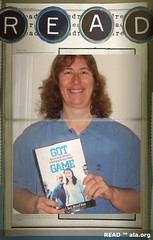
Star in Your Own READ Mini Poster
One of the fun projects I’ve gotten to shepherd at work is now available for you to play with – the READ Mini Poster Generator. It’s just like the generators on fd’s Flickr Toys because it was created by John Watson, Mr. fd himself. Choose from one of four templates and just click the button to upload a picture from your hard drive. (One hint – leave some room above your head in the picture.)
Useful for web badges, profile pictures, and especially graphics for events such as Banned Books Week (which is coming up in September). If you post yours to Flickr, be sure to add it to the READ posters pool. Here’s my first one, but I’m more interested to see how creative everyone else is. I have a series of posters planned. :-)
April 10, 2008
Another Great CiL Conference
Once again I had a great time at the Computers in Libraries conference, even though I didn’t get to stay for the whole thing. I did a preconference with Aaron Schmidt on gaming that was our best one yet, and I got some great feedback about the “Hi Tech, Hi Touch” presentation I was asked to give. I want to give a special thank you to everyone who joined in the fun and made gaming night such a huge success that we’ve already been asked to do it again at Internet Librarian.
Slides from my talks are up on my presentations wiki. Feel free to contact me if you have questions about them. As always, the best thing about these conferences is the people. Spending time with old friends is always special, and I love getting to meet online friends in person. A big thank you to everyone who was so supportive and encouraging – I really appreciated all of your comments.
April 4, 2008
It's Video Week on TSL
Today’s National Library Week video is all about a game, in this case Go Fish. (More NLW videos here.)
April 3, 2008
Dude, That's a Llama
I missed these last year but still laughed when I saw them today. The DePauw Libraries did a takeoff of the Mac-PC ads on the subject of search results, as well as a promo called “Branching Out” dressed up as a Common Craft video!
April 2, 2008
Game Night at CiL on Sunday!
What: Gaming (& Gadgets!) Night
Where: CIL 2008, Jefferson Room
When: Sunday, April 6th, 5:30-8:00 pm
How much: FREE
Who: You and other people interested in gaming
Aaron Schmidt and I have given a few gaming workshops at past Computers in Libraries and Internet Librarian conferences. After the sessions we’ve opened up the room to anyone interested in playing some games and/or learning about gaming. It’s proven to be a popular and really fun time, so this year Information Today has turned the post-workshop gameplay into a featured event. With refreshments even!

We’ve assembled an impressive array of games!
Systems: Nintendo Wii, Playstation 2, and Xbox 360. We’ll also have two Nintendo DS handhelds.
Games: Wii Sports, DDR, Hotel Dusk, Guitar Hero III, Professor Layton and the Curious Village, Wario Smooth Moves, whatever you bring, and Rock Band.
Since we’ll have three systems going at once, we’re opening up the option of an honest to goodness tournament with prizes. You probably want to know which game, huh? Well, it’s up to you. Sign up in the comments on Aaron’s post or at a page we’ve created on the CIL08 wiki titled CIL08 Gaming Night to play Rock Band, Guitar Hero, or DDR. We’ll play whichever game gets the most signups!
In addition, Chris Harris is bringing some modern board games for some casual play (I may bring a couple, too). Bring your own games, bring your latest shiny, new gadgets, and we’ll see you Sunday night!
"But We Also Are"
And we do. Check out the About page of the Technically Random blog.
“We are the Random Technology Un-Committee and we are more what we aren’t than what we are.
We aren’t a committee;
We aren’t a task force;
We aren’t an advisory group;
And, we certainly aren’t organized.
We do not have a charge;
We do not have a mission;
We do not have a task list or a timeline;
We do not have a chair.
But we also are.
We are tinkerers;
We are wonderers;
We are pathfinders;
We are dreamers.
Our sole purpose for existing is to share our thoughts and tinkerings and brainstorming in the hopes of finding new solutions, inspiring more brainstorming and reducing the number of wheels being invented.
And, we do.
We have occasional un-meetings where we sit and share our thoughts and tinkerings. We have no agenda and we do not tolerate blind negativity.
We blog and tag and bookmark whatever we think is interesting and worth sharing.
We may do more, who knows.
Finally, the we who is we is you too. Right now we have a small crew of authors for this blog, but we welcome your participation by either commenting on blog entries, joining our crew of blog authors or participating in our to-be-announced future un-meetings. (Thanks, Kathryn!)