The Shifted Librarian shifting libraries at the speed of byte

March 19, 2008

Visiting the Most Modern Library in the World

Filed under: precat — tsladmin @ 9:12 am

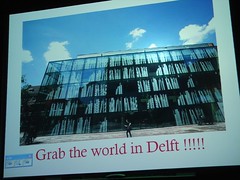
front of DOK Earlier this month I had the incredible good fortune to visit DOK in Delft, Holland. Normally I would call it the Delft Public Library, but it just goes by the name “DOK” and the sign on the door says it’s a “library concept center.” The staff did this on purpose to get away from the traditional stereotypes of the public library, because the institution they’ve created is about as far away as you can get from the connotation of a 1950s building, filled with quiet people, all of them sitting alone, in a relatively dreary building, being shushed by an old lady with a bun.

wonderfully-colorful circulation desk Instead, it is easily the most colorful and aesthetically-pleasing library I have ever seen. Granted, I’ve seen a very small percentage of the world’s libraries, but the use of a diverse palette of bright and unusual colors was a very stark contrast to every other library I have seen in person or in pictures.
Even more impressive (and truly striking) is the amount of radical trust the staff has placed in its patrons. Some of the stark contrast with American libraries is due in part to the litigious nature of our society. Everywhere I went in Delft and in DOK, I found examples of things we could never do in the U.S. out of fear of being sued out of existence. In some cases, it’s as simple as having some of the shelves for childrens books and display cases on wheels so that they can be moved around as needed to create program or play space. The kids can even stand on the bookshelves (as can adults). There’s a room that’s tucked away on the side that truly is built for children, with low benches for sitting and lighting underneath them for little ones who want to read or play on the floor. In another case, it’s the open listening station pods. When I was there, I could hear music drifting through the building from one of them. Some kids would put on an album and let it run while they were elsewhere on the floor talking or playing videogames. It wasn’t overwhelming, though, and there were other places where I couldn’t hear it at all and could sit in silence if I wanted to.

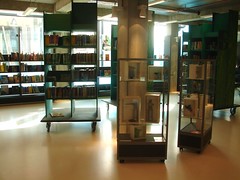
it's okay to stand on the furniture! everything in this part of the kids' area is on wheels the music pods - totally awesome experience

The small design touches everywhere are stunning, but that’s not surprising giving the Dutch aesthetic. DOK easily has the coolest, most comfortable chairs of any library. As I walked around, I kept sitting in them just because I could and wanted to. Some of them are even practical. Recently, I was in a public library in the U.S. where I had trouble finding a comfortable place to sit. My only choice as an adult was the standard box cushion chair with wood arms. Compared to DOK, furniture used in American libraries is at best corporate and at worst unwelcoming. They also use natural language names for sections of the collection (psychology, computers and internet, etc.), not Dewey numbers, and the graphics for the banners are colorful and eye-catching. They are clearly done by a professional, and they don’t all look the same. Also note the lack of steel shelves that make the library look like a warehouse. Instead, they used flexible shelving made from recyclable materials (also done for some gorgeous tables and desks).

the coolest chairs in a library kids relaxing down on the multimedia floor books and their signage

second floor, from the top of the stairs You walk into DOK and you immediately feel welcome into a place you know you can spend hours at if you want to. DOK is what I’ve always wanted libraries to be in terms of the “experience” that happens around books, information, content, media, and people. You can’t help but smile when you’re inside, and you just feel happier in general. A couple of years ago, I heard a speaker at a Minnesota Library Association conference say that the classic mistake libraries make is that we focus too much on how we want people to feel about the library when they walk in. His theory was that we need to focus on how people feel about themselves when they walk in, and DOK illustrates that theory in practice. Each time I entered the building, the bright, natural light from the glass ceiling had an effect on me. If I feel better about myself there, I will feel better about the library and enjoy my experience more.
Eppo, the Director of DOK DOK’s Director, Eppo, told us that “libraries are (for the most part) all about not having fun.” At DOK, they deliberately turned this stereotype on its head. Instead, their theory is that “life is all about having more fun than you can think of, and it starts at the library.” So they have videogames, listening stations, comfortable chairs, a cafe, a circulating art collection, programs throughout the building (not just hidden away in a room in the basement), a piano, toys for kids to play with, a brightly-lit room devoted to graphic novels, an entire room (done in red) devoted to romance novels, and more.
information system that runs off Wiis When you walk in the building for the first time, if your cellphone is discoverable via bluetooth, you’ll receive a text message from DOK that says, “Welcome to the most modern library in the world,” a claim well-lived up to. There’s an RFID system for both library cards and books (with no privacy problems to date). There’s a system of LCD screens mounted around the building for navigation and information which runs off Nintendo Wiis. The display is a Flash application of a Wii channel and the top bar’s information and color changes based on your location in the library. Staff can log in to a website to change what shows on the display in order to update messages for the public (about programs, closings, etc.). The afore-mentioned listening station pods are truly amazing, and I now have to find a way to fund one for my home. Plans for later this year call for the installation of a multimedia creation area for podcasting/vidcasting/etc. and a “genius bar” type of setup for technology help for the public.
None of which precludes the provision of and help finding print materials and reference help. Staff are smartly situated throughout the building, and books are everywhere. Magazines and newspapers are easily accessible, housed in a brilliant design of cubes that makes the most current edition visible and recent issues available without staff intervention. While there are flyers and handouts on top of various shelving, the walls are not plastered with handmade signs of rules and navigation. Of course, there isn’t a single “no cell phones” sign to be found since they actually communicate with patrons via mobile devices.
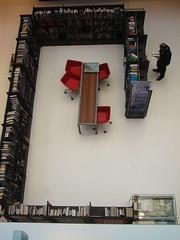
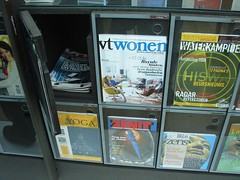
looking down on the new books area from the staff floor magazines are very smartly stored Grab the world at DOK!

I could go on all day about how DOK gets the big things and the details right, but you can see some of this for yourself in my Flickr set. It is everything the big, fancy American libraries want to be but just miss. If your library is planning a new building or a renovation, I highly recommend you talk to the people at DOK and if at all possible, visit this amazing library. You will be amazed at how much better than a bookstore a library can be at merchandising and aesthetics, let alone the social experience.
Addendum: Even better pictures from the DOK folks themselves here, and an article in Marketing Library Services about innovation at DOK here.

March 18, 2008

Videogames and Martinis: 25 Years Later

Filed under: precat — tsladmin @ 10:42 pm

When I talk with skeptics of videogame services in libraries, I remind them that gaming isn’t a new concept for us. Most public (and even school) libraries have some sort of past association with chess, as well as other board games, and most public (and even academic) libraries today realize that some percentage of their users are playing games on the library’s internet terminals. So if chess is okay in the library, how are videogames different, especially the socially-oriented ones that libraries tend to offer?
This isn’t a new question, as I recently learned when Val alerted me to a very public discussion about videogames in libraries that took place back in 1982-83, even spilling over onto the May 9, 1983, “CBS Morning News” show.
It all started with a November 1982 column in School Library Journal by Carol Emmens about four public libraries that were – even back then – circulating videogames. Some quotes from that piece:

“PacMan has invaded restaurants, doctors’ offices, arcades, homes, and the world of television as the star of a Saturday morning cartoon show. And now he has even invaded libraries! He is at the forefront of a new library service–the circulation of video games. A survey turned up four libraries that circulate games.
‘As far as I’m concerned, the circulation of video games is too successful,’ says Harvey Barfield, audiovisual librarian at Arlington Heights Memorial Library (Ill.)….
The library (serving 65,000) owns 400 videocassettes and 50 Atari cartridges, purchased with AV department funds. The combined monthly circulation for videocassettes and games is approximately 2500….
With $1000 seed money provided by the Friends of the Library, [East Brunswick (N.J.) Public Library] bought 55 cartridge locally, and on the first day of service every cartridge was checked out. The Friends donated another $500, and now the cartridge collection totals 105.
[Assistant Director Sharon] Karmazin says, ‘All the cartridges are out all the time and the circulation is really incredible: 235 in July and 259 in August. People hang around the library for hours waiting for returns….
In February, the South River (N.J.) Public Library (serving 14,000) started to circulate 20 cartridges, which had been purchased with $200 donated by the Friends of the Library…. Circulation is very high, and [Director Irene] Cackowski, noting the many new users brought into the library, says, ‘What a service! I can’t say enough good about it.’…
The innovations at Cloquet [(M.N.) Public Library] reflect the philosophy of Head Librarian Mike Knievel, that libraries are not lobbyists for print. He says, ‘The role of the library is not to push books per se, but to acquire, organize, and redistribute information and recreational materials,’ regardless of format.”

Libraries experimenting with videogames and finding them to be a very popular service turned out to be too much for Will Manley, though. He wrote a blistering attack on the practice in the March 1983 edition of Wilson Library Bulletin. As early as 1983, he was sounding the alarm that videogames in the library would be the death of civilization as we know it.

“Nothing, repeat nothing, in eleven years of being a librarian has upset me more than a little, one-page article in the School Library Journal of November 1982, in which the directors of four public libraries boasted about the wonderful success they were having circulating video game cartridges.
Pac Man invades libraries - 1983 Video games! In the public library! Chain saws, paint rollers, hamsters, drill bits–these items for circulation, when we’ve read about them over the past ten years in our professional literature, concerned a number of us as constituting nonsense. But there is something faintly tolerable about nonsense. It’s part of the human condition. We come up against nonsense all the time–at school, the post office, the dentist’s office, and yes, occasionally the public library. But nonsense, once it is accepted for what it is, can even to a degree be funny. The key to nonsense is that it just happens–there is very little rhyme or reason or philosophy to it.
But circulating video games at the public library is not nonsense. It is seriously wrong. It is an abandonment of the mission of the public library. It is surrendering to the commercial and the superficial. It is contrary to everything we stand for….
In effect, video games constitute the most serious threat to that important relationship between children and books since the advent of the television….
The ‘it brings new people into the library’ argument is issuing forth from the lips of more and more librarians, and that’s an indication that we’ve forgotten what a library is all about….
And when those popular services not only don’t complement our focus on the printed word but actually clash against it, then we begin to subvert that commitment [to the common good]….
If we stop standing for the importance of books and information, then we will lose everything.”

All of this must have become so controversial that Manley and Knievel were invited to debate the topic of “print vs. non-print” on “CBS Morning News” with Bill Kurtis. In the same over-the-top tone of his written editorial, Manley proclaimed on the show that, “Offering videogames in libraries is like serving martinis at AA meetings.”
This attitude was overly-simplistic and short-sighted 25 years ago, and it still is today. I’m going to give him the benefit of the doubt that in this day and age, especially with usage statistics supporting the inclusion of non-text materials and programming, that he has since changed his opinion that public libraries should focus only on text on paper.
But the whole thing does illustrate how libraries aren’t just about books, how new content formats are always viewed suspiciously as not being part of the library’s mission, and how that view changes over time once the format becomes more mainstream. Twenty-five years later, it’s important for librarians to realize that videogames are just one more format in a long line of many, and that they are an extension of the same types of services we have provided for decades such as storytime, board games, programs for adults, craft programs for children, meeting space for knitting clubs, computer classes, and more. How could we possibly justify such basic current services as internet access and reference service if we cling to outdated definitions of the library as being focused solely on the written word?
Personally, I believe public libraries are the last safe spaces that serve (and welcome) everyone in the community, regardless of race, economic position, age, or any other factor. Many libraries have worked hard to become the center of their communities, and the concepts of the library as a space for civic engagement and as a “third place” are valid and important roles. The library as a 19th century vault of written knowledge with no other purpose but to raise the moral conscience of the masses through “good” literature is a long-gone proposition. Times change, and libraries need to change with them.
I’m not calling Manley out on his views from 25-years ago, so much as showing that we’re still having these same arguments today and to note that you could substitute “fiction,” “children,” “music,” “computers,” “internet,” or “videos” in any of the above quotes to see where we’ve already been on this. The key is to remember that gaming in libraries in any form is an “and” proposition, not an “or.” It can coexist peacefully with the books, magazines, newspapers, and other services. It’s not the end of the world as we know it.

March 14, 2008

Flying through Pictures

Filed under: precat — tsladmin @ 6:00 am

Check out the cool PicLens browser extension for Firefox or Internet Explorer on Windows or Mac. It gives you a full screen experience of flying through a photostream from a variety of websites. Simply install the extension and a small “play” button will appear over pictures on certain websites (such as Flickr, Facebook, etc.). Click on the play button and you’ll see a wall of the images that you can maneuver through. It’s very cool. Try it on the first photo of your Flickr contacts or on Rita Niland’s pictures from the UGame ULearn conference, but be sure to use it when I post pictures of the amazing DOK and Amsterdam public libraries next week!

my flickrstream in PicLens

I found this cool little toy in CuriousLee’s Flickrstream, which is the type of unintended consequence I’ve been talking about with groups lately. I’m fascinated by how an image sharing site end up being used for bookmarking or knowledge exchange. I wish more library data lived out in the rest of the world so that we could see what kinds of unintended uses spring up around it.

March 12, 2008

Still Time to Win a Wii!

Filed under: precat — tsladmin @ 5:15 am


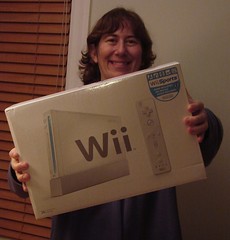
3 days left to win a Wii!
Originally uploaded by The Shifted Librarian

Just a reminder that you still have three days to make a donation to LIShost and win a Nintendo Wii! More info here.

March 11, 2008

Links to Presentations

Filed under: precat — tsladmin @ 5:55 am

It’s been a crazy couple of weeks, but I’ve had the pleasure of giving a flurry of presentations that I promised attendees I’d link to from here. I love that the Illinois educators I spoke to at the end of February were just as enthusiastic as the Dutch librarians who attended my presentations in the Netherlands. Thank you to everyone who came to them all and helped make this a very special time for me.
I’m still uploading pictures from the Netherlands trip on Flickr, but I will definitely post about the amazing Delft and Amsterdam libraries I had the great fortune to visit (special Flickr sets to appear online soon).

February 27, 2008

Mutating Libraries

Filed under: precat — tsladmin @ 10:21 pm

Slate has an interesting slideshow with the slightly misleading title Borrowed Time: How Do You Build a Public Library in the Age of Google. I say misleading, only because the author literally means “build,” as in physical building. It doesn’t take into account staff or any web-based services at all, so why even mention Google? Even though it’s an incomplete picture, I found the last slide especially interesting.

“Ross Dawson, a business consultant who tracks different customs, devices, and institutions on what he calls an Extinction Timeline, predicts that libraries will disappear in 2019. He’s probably right as far as the function of the library as a civic monument, or as a public repository for books, is concerned. On the other hand, in its mutating role as urban hangout, meeting place, and arbiter of information, the public library seems far from spent. This has less to do with the digital world—or the digital word—than with the age-old need for human contact.”

I missed Dawson’s original post about the extinction timeline last year, so it was news to me that libraries will disappear in just 11 years. I tend to agree more with the Slate author because for me, libraries are about a lot more than just books or study carrels. That’s why I think there’s room for things like gaming in today’s library. (Thanks, Dad!)

February 19, 2008

What Do Games Have to Do with Literacy?

Filed under: precat — jenny @ 10:48 pm

I’ve been telling everyone who will listen about Paul Waelchli’s work mapping the ACRL Information Literacy Standards to skills used to play popular videogames. I’ve been waiting for someone to do the same thing for school libraries, and now we have our first step towards that goal because Brian Mayer has mapped New York State’s education standards to some modern board games.
Gaming, School Libraries and the Curriculum

“Games engage students with authentic leisure experiences while reinforcing a variety of social, literary and curricular skills. When an educational concept is introduced and reinforced during a game, it is internalized as part of an enjoyable experience and further utilized as one aspect of a strategy to attain success.
Games also carry other benefits. They help students connect and build social skills, working as part of a team or negotiating the most advantageous situation for themselves. It also provides an opportunity for students to to explore a host of life skills not inherent in the curriculum , but important for success. Some of these include: micro-managing resources and options; actively re-evaluating, re-prioritizing and re-adjusting goals based on uncertain and shifting situations; determining acceptable losses in an effort to obtain an end goal; and employing analytical and critical skills to more authentic social experiences.
Here is a list of NYS standards currently supported by a well established school game library:
NYS Social Studies Standards:

  • Standard 3: Geography Students will use a variety of intellectual skills to demonstrate their understanding of the geography of the interdependent world in which we live—local, national, and global—including the distribution of people, places, and environments over the Earth’s surface.
  • Standard 4: Economics Students will use a variety of intellectual skills to demonstrate their understanding of how the United States and other societies develop economic systems and associated institutions to allocate scarce resources, how major decision-making units function in the U.S. and other national economies, and how an economy solves the scarcity problem through market and non-market mechanisms.

Several more are listed in the post, so please click through to see just how good a fit this can be.
If you still question whether there are literacies (especially information-related ones) involved in playing videogames, ask yourself if those same things happen around playing board games. If your answer is that yes, they do, what then is the difference between learning those skills through board games and learning them through videogames? Brian’s work helps illustrate the similarities but even more importantly, it shows how easily a school library could start out with the familiar world of board games as a way to implement gaming services and engage students more interactively in learning information literacy skills. Thanks, Brian!

February 18, 2008

Lots of Happenings in LibraryLand

Filed under: precat — jenny @ 11:13 pm

Superpatron Ed Vielmetti is speculating that Ann Arbor District Library might be getting ready to connect Twitter and the Library. Not that I’m putting any pressure on AADL, but if anyone was going to do it, I’d expect it to be them.

“Once upon a time I built a ‘superpatronbot‘ that searched the AADL catalog via a Jabber bot – quite reasonably you could build one of these upon Twitter’s direct message listings. Useful? Perhaps, especially if I could link a Twitter account to my library card and then be able to twitter
d aadl reserve anatomy of a murder dvd
and have it do a hold on it for me (or return some disambiguator if there were multiple choices).”

You can find the new, announcements Twitter feed for AADL at http://twitter.com/aadl.
If you want to ask AADL staff what they’re up to these days, head to the Library Camp taking place there on March 20. It’s free to attend, and the discussions are sure to fire up your brain.
I won’t be able to attend because I will be kicking off the day at the SOLINET/OCLC CAPCON event Changing the Way Libraries Do Business: Meeting the Challenges of the Web 2.0 World in Arlington, Virginia. I’ll be giving an overview of 2.0, but I’m really looking forward to hearing the other speakers for the day – Kate Sheehan, Jamie Coniglio, Jennifer Howell, and Karen Calhoun. You can still register, and you attend, please be sure to say hi.
If you can’t make either of these great events, you can try for Library Camp Kansas the day before, on March 19, another unconference that promises some great discussions.

February 15, 2008

Syracuse Library Game Lab Gets Funding from Gaylord

Filed under: precat — jenny @ 6:17 am

Shout out to Gaylordg for helping get this project off the ground.
Professor receives grant to bring gaming to libraries, other campuses

“[Scott] Nicholson, an associate professor in the School of Information Studies, recently received a $5,000 grant from Gaylord Brothers, a library supply company located in Syracuse, to begin building a portable library game lab. Money from the grant will specifically go toward purchasing projectors, consoles, screens, accessories and games, Nicholson said.
‘This was a great way for Gaylord to support Syracuse University, the community and gaming libraries in general,; said Henry Orr, director of business development at Gaylord. He also noted that the credit for the grant should go to Gaylord’s President and CEO Guy Marhewka….
Nicholson’s goal is to explore the implications of offering gaming as a library service. Additionally, he hopes to study the entire gaming experience and how gaming will change the attitudes of students toward the library.
‘Gaming activities are like the new coffee shop in Bird Library; it’s not about the coffee so much as the social atmosphere it creates,’ Nicholson said….
‘Gaming is currently the wild, wild west of libraries,’ Orr said….
The Library Game Lab project will occur in three main phases, depending on the availability of outside funding. Nicholson has been working on the first phase of the project for the past year, working with students to survey libraries and how they view gaming….
The project’s current phase, to create a portable library game lab, will be followed by the next phase, to increase awareness about the project.
‘With this project, I will travel to library conferences and expose librarians to the spectrum of games, talk about what types of games are best for certain demographic groups with libraries and collect more data about what is happening,’ Nicholson said.
The third and final phase of the project will be to set up research projects, which will explore how the different types of games relate to different types of people.
‘This will be the ongoing life of the lab – to analyze new games and game types, to recommend the best games for different goals and demographic groups and to work with industry to help them create gaming experiences more suited for a library/school setting,’ Nicholson said.
Nicholson said as soon as he is able to secure more funding to build the program, he hopes to start aggressively drawing in students to help with the project. So far he has relied heavily on volunteers to help with research and promoting the program. In addition, Nicholson is teaching a graduate-level iSchool class in May on gaming in libraries, and it has already received considerable student interest.
There has been both support and criticism from the Syracuse community at large regarding the Library Game Lab, but Nicholson said the key is getting people to understand that this is not about ‘first person shooters,’ but rather about ‘understanding how gaming works as a service and how libraries and schools can be engaged.’ ” [The Daily Orange]

February 13, 2008

Win a Wii and Thank Blake, All at the Same Time

Filed under: precat — jenny @ 11:30 am

If you’re a regular online, you probably know or know of Blake Carver. Even if you’ve never met him, you know his work. He’s been running and maintaining the incredible LISNews hub since 1999. This contribution alone is why many of us admire him for his dedication and vision.
In 2002, Blake started LISHost, an affordable website hosting service for libraries and libraries. On the very rare occasion the LISHost server goes down, you can tell something’s amiss because half the known LIS world must house their sites there. I do, as does Michael Stephens, and we can both tell you from first-hand experience that Blake does a superhuman job of maintaining the server (especially security) and providing technical support.
I can’t think of a time when Blake hasn’t responded immediately when there was a problem, when he said no to a request to add software just for me, or when he didn’t come up with a creative solution to a problem no one else would have wanted to deal with. And for all of his hard work (truly, the man must not sleep), he charges next to nothing for the services you get.
Win a Wii! So to thank him for all of his efforts, both on our behalf and for the profession, Michael and I are raffling off a Nintendo Wii to help show our appreciation in the form of a fundraiser. Please note that neither LISHost nor LISNews is in financial trouble, and this is not a call to “save” them. This is simply a way for us to acknowledge Blake’s efforts and thank him for everything he does.
So here’s how it works. Everyone who donates $10 or more to LISHost by 11:59 p.m. on March 14, 2008, will be eligible to win the Wii. We’ll pull a name out of the digital hat, so-to-speak, and send you the Wii if you’re the lucky winner. To enter/donate, click on the button below. Your donation is your entry, as we’ll have a full list of names from Paypal.
Update: The donation period has closed. Thanks to those of you who contributed!

« Newer Posts — Older Posts »

Powered by WordPress