When I talk with skeptics of videogame services in libraries, I remind them that gaming isn’t a new concept for us. Most public (and even school) libraries have some sort of past association with chess, as well as other board games, and most public (and even academic) libraries today realize that some percentage of their users are playing games on the library’s internet terminals. So if chess is okay in the library, how are videogames different, especially the socially-oriented ones that libraries tend to offer?
This isn’t a new question, as I recently learned when Val alerted me to a very public discussion about videogames in libraries that took place back in 1982-83, even spilling over onto the May 9, 1983, “CBS Morning News” show.
It all started with a November 1982 column in School Library Journal by Carol Emmens about four public libraries that were – even back then – circulating videogames. Some quotes from that piece:
“PacMan has invaded restaurants, doctors’ offices, arcades, homes, and the world of television as the star of a Saturday morning cartoon show. And now he has even invaded libraries! He is at the forefront of a new library service–the circulation of video games. A survey turned up four libraries that circulate games.
‘As far as I’m concerned, the circulation of video games is too successful,’ says Harvey Barfield, audiovisual librarian at Arlington Heights Memorial Library (Ill.)….
The library (serving 65,000) owns 400 videocassettes and 50 Atari cartridges, purchased with AV department funds. The combined monthly circulation for videocassettes and games is approximately 2500….
With $1000 seed money provided by the Friends of the Library, [East Brunswick (N.J.) Public Library] bought 55 cartridge locally, and on the first day of service every cartridge was checked out. The Friends donated another $500, and now the cartridge collection totals 105.
[Assistant Director Sharon] Karmazin says, ‘All the cartridges are out all the time and the circulation is really incredible: 235 in July and 259 in August. People hang around the library for hours waiting for returns….
In February, the South River (N.J.) Public Library (serving 14,000) started to circulate 20 cartridges, which had been purchased with $200 donated by the Friends of the Library…. Circulation is very high, and [Director Irene] Cackowski, noting the many new users brought into the library, says, ‘What a service! I can’t say enough good about it.’…
The innovations at Cloquet [(M.N.) Public Library] reflect the philosophy of Head Librarian Mike Knievel, that libraries are not lobbyists for print. He says, ‘The role of the library is not to push books per se, but to acquire, organize, and redistribute information and recreational materials,’ regardless of format.”
Libraries experimenting with videogames and finding them to be a very popular service turned out to be too much for Will Manley, though. He wrote a blistering attack on the practice in the March 1983 edition of Wilson Library Bulletin. As early as 1983, he was sounding the alarm that videogames in the library would be the death of civilization as we know it.
“Nothing, repeat nothing, in eleven years of being a librarian has upset me more than a little, one-page article in the School Library Journal of November 1982, in which the directors of four public libraries boasted about the wonderful success they were having circulating video game cartridges.
Video games! In the public library! Chain saws, paint rollers, hamsters, drill bits–these items for circulation, when we’ve read about them over the past ten years in our professional literature, concerned a number of us as constituting nonsense. But there is something faintly tolerable about nonsense. It’s part of the human condition. We come up against nonsense all the time–at school, the post office, the dentist’s office, and yes, occasionally the public library. But nonsense, once it is accepted for what it is, can even to a degree be funny. The key to nonsense is that it just happens–there is very little rhyme or reason or philosophy to it.
But circulating video games at the public library is not nonsense. It is seriously wrong. It is an abandonment of the mission of the public library. It is surrendering to the commercial and the superficial. It is contrary to everything we stand for….
In effect, video games constitute the most serious threat to that important relationship between children and books since the advent of the television….
The ‘it brings new people into the library’ argument is issuing forth from the lips of more and more librarians, and that’s an indication that we’ve forgotten what a library is all about….
And when those popular services not only don’t complement our focus on the printed word but actually clash against it, then we begin to subvert that commitment [to the common good]….
If we stop standing for the importance of books and information, then we will lose everything.”
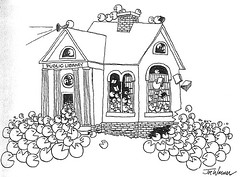
All of this must have become so controversial that Manley and Knievel were invited to debate the topic of “print vs. non-print” on “CBS Morning News” with Bill Kurtis. In the same over-the-top tone of his written editorial, Manley proclaimed on the show that, “Offering videogames in libraries is like serving martinis at AA meetings.”
This attitude was overly-simplistic and short-sighted 25 years ago, and it still is today. I’m going to give him the benefit of the doubt that in this day and age, especially with usage statistics supporting the inclusion of non-text materials and programming, that he has since changed his opinion that public libraries should focus only on text on paper.
But the whole thing does illustrate how libraries aren’t just about books, how new content formats are always viewed suspiciously as not being part of the library’s mission, and how that view changes over time once the format becomes more mainstream. Twenty-five years later, it’s important for librarians to realize that videogames are just one more format in a long line of many, and that they are an extension of the same types of services we have provided for decades such as storytime, board games, programs for adults, craft programs for children, meeting space for knitting clubs, computer classes, and more. How could we possibly justify such basic current services as internet access and reference service if we cling to outdated definitions of the library as being focused solely on the written word?
Personally, I believe public libraries are the last safe spaces that serve (and welcome) everyone in the community, regardless of race, economic position, age, or any other factor. Many libraries have worked hard to become the center of their communities, and the concepts of the library as a space for civic engagement and as a “third place” are valid and important roles. The library as a 19th century vault of written knowledge with no other purpose but to raise the moral conscience of the masses through “good” literature is a long-gone proposition. Times change, and libraries need to change with them.
I’m not calling Manley out on his views from 25-years ago, so much as showing that we’re still having these same arguments today and to note that you could substitute “fiction,” “children,” “music,” “computers,” “internet,” or “videos” in any of the above quotes to see where we’ve already been on this. The key is to remember that gaming in libraries in any form is an “and” proposition, not an “or.” It can coexist peacefully with the books, magazines, newspapers, and other services. It’s not the end of the world as we know it.
Well said Shifted. That is an eye opener, to realize that 25 years ago people were talking about gaming. And yet, people still mention the topic with wonderment, surprise, and/or awe.
But in my opinion that is a good thing. I remember those teens when we firt turned on the guitar hero on the big huge drop down screen and the speakers were blasting at supreme wattage. You could tell those kids had no idea the library could be so cool.
Yes the library can be the new ‘third place’, but it can also be the ‘cool third place’.
And remember, without gaming we wouldn’t have librarians facing off against patrons on DDR over library fines.
Comment by royce — March 19, 2008 @ 6:10 am
I think it’s critical that libraries are providing a video game experience, not just video game materials.
Comment by dorkey kong — March 19, 2008 @ 7:00 am
[…] http://www.theshiftedlibrarian.com/archives/2008/03/18/videogames-and-martinis-25-years-later.html‘As far as I’m concerned, the circulation of video games is too successful,’ says Harvey Barfield, audiovisual librarian at Arlington Heights Memorial Library (Ill.)…. The library (serving 65000) owns 400 videocassettes and 50 Atari … […]
Pingback by OJ is innocent. It was Audiovisual Librarians » Blog Archive » What others have been saying about audiovisual librarian — March 19, 2008 @ 11:28 am
[…] http://www.theshiftedlibrarian.com/archives/2008/03/18/videogames-and-martinis-25-years-later.html‘As far as I’m concerned, the circulation of video games is too successful,’ says Harvey Barfield, audiovisual librarian at Arlington Heights Memorial Library (Ill.)…. The library (serving 65000) owns 400 videocassettes and 50 Atari … […]
Pingback by OJ is innocent. It was Audiovisual Librarians » Blog Archive » Quick Roundup — March 22, 2008 @ 11:13 am
[…] http://www.theshiftedlibrarian.com/archives/2008/03/18/videogames-and-martinis-25-years-later.html‘As far as I’m concerned, the circulation of video games is too successful,’ says Harvey Barfield, audiovisual librarian at Arlington Heights Memorial Library (Ill.)…. The library (serving 65000) owns 400 videocassettes and 50 Atari … […]
Pingback by OJ is innocent. It was Audiovisual Librarians » Blog Archive » ‘audiovisual librarian’ on the web — March 24, 2008 @ 11:27 am
[…] sad. So I suggest to reading this to cleanse your palate of that awful taste of bitter librarian: Videogames and Martinis: 25 years later It’s much more useful than calling someone stupid….which as librarians we should all […]
Pingback by Like Cat Stephens, I can’t keep it in. « La de da — March 24, 2008 @ 3:58 pm
[…] Videogames and Martinis: 25 Years Later […]
Pingback by Historien om tv-spel pÃ¥ bibliotek « Spelbiblioteket — March 31, 2008 @ 7:32 am
[…] the Shifted Librarian – Videogames and Martinis: 25 years later […]
Pingback by Gamla nyheter - eller: « Bibtech142 - SkogÃ¥s Bibblablogg — April 4, 2008 @ 7:40 am