January 11, 2010

One Approach to Org Twitter Accounts

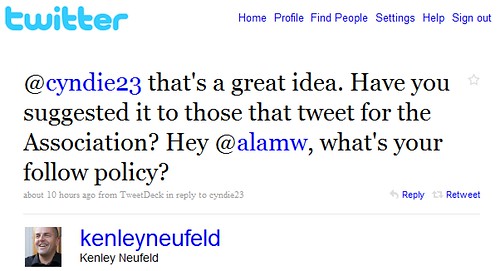
I’ve been mulling over this post for sev­eral weeks now, but a con­ver­sa­tion that hap­pened on Twit­ter today prompted me to finally write and pub­lish it. It started when Ken­ley Neufeld wrote a post about par­tic­i­pat­ing in ALA and tweeted the link. Cyndi E. engaged Ken­ley in a con­ver­sa­tion about ALA fol­low­ing its mem­bers back on Twit­ter, which led Ken­ley to ask ALA’s Mid­win­ter Meet­ing account what its fol­low pol­icy is.

what's your follow policy?

Well, I work for ALA, and I run that account (along with three oth­ers), plus my per­sonal one. The “royal” ALA has no offi­cial social media pol­icy, although there is an inter­nal staff task force work­ing on one. I’m not on that group and I haven’t wanted to step on any toes, which is why I haven’t said much online about this topic, but that doesn’t mean I haven’t thought through some things for the accounts I man­age. Given today’s con­ver­sa­tion, I thought I’d share my approach and solicit feed­back for what you think is and isn’t working.

Before I go any fur­ther, though, I want to note that I kind of fly by the seat of my pants with this stuff at work. I already have a cou­ple of full time roles (as does pretty much every­one at ALA HQ), and track­ing what’s said about MPOW online is pretty near impos­si­ble these days. Amongst the good and bad about the Amer­i­can Library Asso­ci­a­tion, the term “ALA” also gets used for A List Apart (espe­cially when they pub­lish a new issue), the abbre­vi­a­tion for “Alabama” in news reports, Ala Moana in Hon­olulu, ala mode, “ala” mean­ing “in the style of,” in Span­ish, and more. I do the best I can, but no one per­son could catch it all unless it was their only job respon­si­bil­ity. I know a lot of folks strug­gle to get sup­port from the top in their orga­ni­za­tion, and I’m lucky that this isn’t one of the bat­tles I have to fight.

All of which is my way of say­ing, your mileage may vary, even within ALA. These are just my thoughts for how I’m han­dling four Twit­ter accounts at work, and I’d love to hear how you think I could do this bet­ter. Maybe this list willl even give you some pro­ce­dural ideas for your own institution’s efforts.

I mainly mon­i­tor and man­age Twit­ter and Friend­Feed accounts, so that’s where I focus my efforts. I’m lucky that oth­ers have taken on the man­tle of man­ag­ing ALA’s Face­book, LinkedIn, Sec­ond Life, and YouTube pres­ences. These are the guide­lines I’ve been fol­low­ing for Twit­ter (I still need to imple­ment most of these on FriendFeed).

  1. My goals for the accounts are to lis­ten, answer ques­tions, inter­act, and inform.
  2. I fol­low most pub­lic accounts that fol­low us, as long as its not a spam­mer, bot, or “social media expert” who has thou­sands of fol­low­ers. I don’t have any­thing against the gurus, but they’re not the audi­ence I want to inter­act with. It may take me a week to log in and fol­low all the new folks, but that’s my goal. I’m some­what pas­sive about this because of the lack of an easy way to han­dle fol­low­ers from one source, although right now I’m actively try­ing to fol­low any human being who say they’re attend­ing our Mid­win­ter Meet­ing this week. I do this to make it eas­ier to lis­ten and respond, plus it gives these folks the abil­ity to direct mes­sage us.
  3. The excep­tion to rule #2 is that I don’t fol­low pri­vate accounts. I real­ize some folks make their accounts pri­vate to avoid spam­mers, but I can’t tell those from the folks who truly want their tweets to be pri­vate. As an orga­ni­za­tional account that mul­ti­ple staff mem­bers might have access to, I don’t want to expose those tweets or set up a sit­u­a­tion where some­one might acci­den­tally retweet some­thing private.
  4. I try to do more than just click a book­marklet, so I’ll rephrase con­tent to get it down to 130 char­ac­ters or some­how add value to the head­line of a press release. I try to be human and avoid mar­ket­ing speak, and I don’t get hung up on cap­i­tal­iza­tion, even though my under­grad­u­ate degree is in journalism.
  5. I do my best to shoot for 130 char­ac­ters to pro­vide for easy retweetability.
  6. Although this doesn’t apply to all orga­ni­za­tions, I’m a big believer in the “right of first tweet.” Within ALA, there’s no one “mas­ter” Twit­ter account for the Asso­ci­a­tion as a whole. Instead, every office, divi­sion, round table, etc., has its own account. In order to help build the audi­ence for those accounts and give credit, I try to not announce news first that really belongs to other ALA units. Instead, I do my best to retweet their tweets. That doesn’t always hap­pen, but I think it’s their right to have the first shot at it.
  7. Some­thing new I’ve been try­ing lately is to avoid retweet­ing some­one else’s con­tent imme­di­ately after they tweet it, espe­cially if they’ve used a hash­tag. Instead, I use Hoot­Suite to sched­ule the tweet at a dif­fer­ent time of day in order to try to reach a dif­fer­ent audi­ence that may not have seen the orig­i­nal one. If it was a morn­ing tweet, I’ll sched­ule the retweet for the after­noon, and vice versa.
  8. I’m cur­rently using bit.ly to shorten URLs so that I can get sta­tis­tics for how often links are being fol­lowed. I also try to use cus­tom bit.ly URLs for links I know I’ll re-use a lot. I fer­vently wish Hoot­Suite would get rid of the frames on its ow.ly ser­vice or at least give URL cre­ators the option to turn them off. Until then, I’ll keep using bit.ly.
  9. I delib­er­ately retweet from indi­vid­u­als, not just other ALA units or orga­ni­za­tions. My take on it is that we’re all in this together, and we’re all part of the con­ver­sa­tion. Of course, that doesn’t mean I’ll be retweet­ing every­thing posted to the #nopants tag. ;-)
  10. Rather than count­ing the num­ber of fol­low­ers as a met­ric, I’ve started track­ing con­ver­sa­tions. I still haven’t found what I con­sider to be an opti­mal way to do this, but for the moment, I’m clip­ping tweets to a note­book in my Ever­note account (I’m on the free ser­vice for now) so that I can find them again. Because it’s so dif­fi­cult to track the term “ALA,” I haven’t found an easy way to report out what’s being said about us, other than by man­u­ally writ­ing up an email.
  11. Per­son­ally, I have an unlim­ited text mes­sag­ing plan (I <3 texting), so I use notify.me to have Twit­ter men­tions sent to my phone via SMS so that I get imme­di­ate alerts when some­one men­tions or directs a tweet to one of the ALA accounts. If you don’t want to go the SMS route, you can have the noti­fi­ca­tions sent to an email address, instant mes­sag­ing account, or to a desk­top app/widget. And this setup doesn’t nec­es­sar­ily mean I respond right away, espe­cially if I’m out with friends, watch­ing a movie, or if it’s late at night. I’ve worked hard to bal­ance my work and per­sonal lives, and so far it’s work­ing fairly well. But the notice gives me a heads up, and I can then assess the urgency.

Those are the var­i­ous Twit­ter issues I’ve thought through so far. Based on some other prob­lems that have come up at work, I have some gen­eral advice for other orga­ni­za­tions using social sites.

  • Did you know that the per­son who cre­ates a Face­book page can never be removed? Never, ever, ever, ever plus a day. The only way is to delete the person’s account, which an orga­ni­za­tion can’t do if it’s a per­sonal account. So be care­ful about who cre­ates your organization’s page(s), because you’ll never be able to remove that per­son as an admin. You can add other admins, but you can’t remove the orig­i­nal cre­ator. Add my voice to the cho­rus of frus­trated users who wish Face­book would change this pol­icy yesterday.
  • Be very care­ful when you’re set­ting up your bit.ly links. If you acci­den­tally paste in the wrong URL (which I’ve done), you can’t go back and change it. Ever, as in ever plus a day. If you mess up a cus­tom URL, you’ll never be able to get it back. Ever. Did I men­tion ever?
  • And speak­ing of bit.ly, if you haven’t already done this, you might want to go grab the most obvi­ous cus­tom bit.ly URLs for your orga­ni­za­tion so that some­one else doesn’t use/steal/hijack them. Espe­cially if you want a short and easy way to point to your own site on Twit­ter and get sta­tis­tics for num­ber of clicks. You can decide if you want to do this on other URL short­en­ing ser­vices, too.

So those are some quick thoughts that have been swim­ming around in my head. I’d love to hear your thoughts about how I can do this bet­ter, and what you’d like to see from the ALA accounts I run.
Tags: ala, blogpost, facebook, mpow, social media, social networking, twitter

September 15, 2009

How Librarians Helped Get Out the Vote… in 1952

I love serendip­ity. While I was prepar­ing for my ACPL Library Camp pre­sen­ta­tion about libraries and civic engage­ment, I saw a post on the Civic Engage­ment blog in which Nancy Kranich pointed to a fas­ci­nat­ing arti­cle on the topic.

Pro­mot­ing Cit­i­zen­ship: How Librar­i­ans Helped Get Out the Vote in the 1952 Pres­i­den­tial Elec­tion,” Libraries & the Cul­tural Record 43 no1 1–28 2008 (Unfor­tu­nately, it doesn’t appear to be online in its entirety, but you can get the full text through Gale’s Aca­d­e­mic OneFile.)

I think this fas­ci­nat­ing arti­cle pin­points the moment in time when libraries became known for pro­vid­ing high-quality, accu­rate, authen­tic infor­ma­tion about all sides of an issue. Its cer­tainly the point at which libraries became out­lets for infor­ma­tion about vot­ing. In a fas­ci­nat­ing look back, author Jean Preers chron­i­cles the efforts made to civi­cally engage Amer­i­cans and increase voter turnout in the 1948 and 1952 elections.

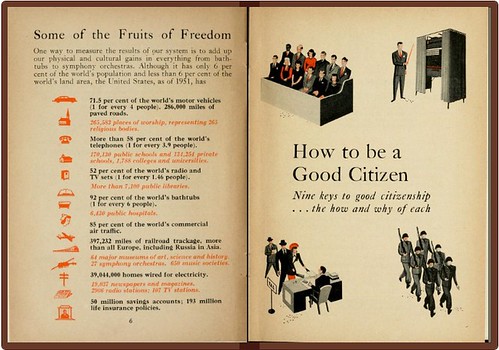
It starts with an ini­tia­tive by the Amer­i­can Her­itage Foun­da­tion in 1947, which results in the book­let Good Cit­i­zen: The Rights and Duties of an Amer­i­can, a con­fer­ence, and the Free­dom Train, an actual train that trav­eled across the coun­try exhibit­ing “orig­i­nal doc­u­ments that that estab­lished the nation’s demo­c­ra­tic tra­di­tion, from the Bill of Rights to the Eman­ci­pa­tion Procla­ma­tion.” The book­let is a won­der­ful arti­fact — I highly rec­om­mend it as a his­tor­i­cal snap­shot, and thank­fully it’s avail­able on the Inter­net Archive, thanks to the Uni­ver­sity of Florida’s George A. Smath­ers Libraries.

Good Citizen: The Rights and Duties of an American

Dur­ing this time, the Amer­i­can Library Asso­ci­a­tion (dis­claimer: my employer, although I wasn’t even born back then) “under­took its own pro­gram to pro­mote the dis­cus­sion of cur­rent issues in pub­lic libraries. This was a direc­tion long-favored by its Exec­u­tive Direc­tor Carl Milam, and, as part of its “Four Year Goals” in 1948, ALA had ini­ti­ated a pro­gram called Great Issues, which urged librar­i­ans to high­light such top­ics as U.S.-Russian rela­tions, civil rights, and world gov­ern­ment in their col­lec­tions and programs.”

Librar­i­ans started cre­at­ing bib­li­ogra­phies for these top­ics and encour­aged com­mu­nity orga­ni­za­tions to form read­ing and dis­cus­sion groups around them.

Ruth Ret­zen, chair of ALA’s Adult Edu­ca­tion Board, saw this as an oppor­tu­nity for libraries to take the lead in their com­mu­ni­ties, direct­ing their pro­grams towards wider cir­cu­la­tion of per­ti­nent infor­ma­tion: ‘Let us make our libraries active com­mu­nity cen­ters for the spread of reli­able infor­ma­tion on all sides of this vital issue and for the encour­age­ment of free dis­cus­sion and action.’ ”

Unfor­tu­nately, none of these efforts really suc­ceeded, and voter turnout for the 1948 elec­tion was “sur­pris­ingly low.” To cel­e­brate its 75th anniver­sary in 1951, ALA changed direc­tion and used a $150,000 grant from the Ford Foun­da­tion to help libraries imple­ment read­ing and dis­cus­sion groups them­selves. [Iron­i­cally, “this nation­wide adult edu­ca­tion pro­gram began in the fall of 1951 just as National Library Day obser­vance in Phli­adel­phia on Octo­ber 4 effec­tively con­cluded the seventy-fifth anniver­sary cel­e­bra­tion.” All Philadel­phia libraries are cur­rently set to close on Octo­ber 2, 2009, unless the Penn­syl­va­nia Leg­is­la­ture acts to save them.]

As ALA began to ramp up its pro­gram, the AHF con­tin­ued to work on increas­ing voter turnout for the 1952 elec­tion. The folks behind the AHF pro­gram real­ized that guilt­ing peo­ple into vot­ing wasn’t work­ing (and wasn’t likely to start work­ing any­time soon), so they also changed direc­tion to sim­ply “pro­vide ade­quate infor­ma­tion and mate­ri­als to imple­ment the will of the peo­ple.” An enhanced focus on civic and non­profit orga­ni­za­tions brought ALA and libraries into the effort as the cen­tral source cit­i­zens could go to in order to find unbi­ased infor­ma­tion. ALA agreed, in part because this meant the AHF and other orga­ni­za­tions would pro­mote this new role and encour­age their mem­bers to seek out libraries specif­i­cally for unbi­ased infor­ma­tion that could then be used to reg­is­ter local vot­ers. Accord­ing to Preers, this is also when libraries take on the man­tle of library adult edu­ca­tion, another new role.

It truly is a thought-provoking arti­cle (there’s a lot more to it, so you really should read the whole thing), and it high­lights one of the themes that’s res­onated with me per­son­ally dur­ing the last 12–18 months, that when we talk about how the library “used to be,” we have to be very spe­cific about which era we’re refer­ring to. As I’ve noted in the past about gam­ing, children’s ser­vices are a rel­a­tively recent addi­tion to libraries, as are fic­tion, mul­ti­me­dia, and even pub­lic access (see my brief post about D. W. Krummel’s The Seven Stages of Librar­i­an­ship for more about this).

More impor­tantly, it helps show how proac­tive civic engage­ment is not a new role for 21st cen­tury libraries. We’ve done this before — suc­cess­fully — and we can do it again — suc­cess­fully — if we focus on spe­cific areas. For exam­ple, stud­ies show that gam­ing in libraries could include civic engage­ment expe­ri­ences. I’m also inter­ested in the “Great Issues” pro­gram to offer the library as a por­tal to civic dis­course around many of the “great” issues that aren’t eas­ily acces­si­ble to the aver­age per­son. Pri­vacy, dig­i­tal iden­tity, online rep­u­ta­tion, media lit­era­cies, trans­par­ent gov­ern­ment… there’s a wide range of top­ics that need addressing.

The ques­tion is can librar­i­ans (and not just pub­lic librar­i­ans) still pro­vide this type of ser­vice? I ques­tion if there’s any­one else who can.

Tags: ala, american heritage foundation, american library association, civic engagement, elections, libraries, voting

8:29 am Comments (3)

March 5, 2009

PCMA Presentation: Embracing Free Technology in a Global Recession

Today I was part of a panel ses­sion about Web 2.0 tools for the GMC/PCMA

Greg Fine — Asso­ci­a­tion Forum

showed some of their Asso­ci­a­tion Pro­fes­sion­als through­out His­tory video
showed the map of online com­mu­ni­ties from 2007 (“gulf of youtube”)
social media is about build­ing com­mu­nity, and Greg likes this visual because it shows there are actual places and you can’t just aim­lessly wan­der around
– it lets you lever­age exist­ing net­works
– it allows us to eas­ily cre­ate and share infor­ma­tion with one another (as asso­ci­a­tions, we’re about asso­ci­at­ing)
– allows this to hap­pen in an instan­ta­neous way
– on a plat­form that peo­ple are com­fort­able with
so if we as orga­ni­za­tions lever­age these plat­forms, we make it eas­ier for our mem­bers to find us and inter­act with us
– it allows you to evan­ge­lize your mem­bers and your customers

there are gen­er­a­tional dis­tinc­tions — gen­er­ally accepted dis­tinc­tions
uses accept­able footwear for men on day one of their new job as way to dis­tin­guish between them
great­est gen­er­a­tion — wingtips
Xers — black lace-up, but moved to the boat shoe
Millennials/GenY — ten­nis shoes
Gamers — flip-flops
can’t talk to a flip-flop from a wingtip per­spec­tive
even the ten­nis show crowd may not totally get the flip-flop one
also have the 80–20-1 rule
80% of peo­ple who are on the inter­net only look/lurk and don’t engage
20% of the 80% actively engage (read RSS, have a Face­book page)
1% of that 20% are active users of social media online (blog, post to Wikipedia, etc.)
EXCEPT for the gamers, where the num­bers are reversed
only 1% are not active online, etc.

the #1 rule is that the orga­ni­za­tion totally loses con­trol in this envi­ron­ment
if some­one wants to say some­thing bad about you, they don’t need your site/platform to do it
so embrace it
do you use free or pro­pri­etary and build your own?
Greg is a big believer in free
– free
– pro­pri­etary usu­ally means sep­a­rate authen­ti­ca­tion scheme and peo­ple have pass­word fatigue now
– do you have an open or closed sys­tem (can any­one be a mem­ber or is it a mem­ber benefit)

Asso­ci­a­tion Forum makes every­thing open because if you care enough to join, maybe you’ll even­tu­ally become a mem­ber
there’s no right or wrong, but you need to be delib­er­ate about what you’re going to do

set rea­son­able expec­ta­tions
men­tioned a case where a group thought they’d failed because they only had 1,200 peo­ple on their Face­book page
but they only had 10,000 mem­bers total!

you can­not think like you — you have to think like your audi­ence
just because you don’t use it doesn’t mean oth­ers shouldn’t
oth­ers may cre­ate these sites (like a Face­book page) for you if you don’t do it
you have to inte­grate it with tra­di­tional meth­ods
you don’t just do one thing in iso­la­tion — f2f, email newslet­ters, etc. are still valid
taken all together, it makes it all more valuable

it’s like a foot­ball expe­ri­ence — it’s the future of the asso­ci­a­tion expe­ri­ence
the audi­ence in the sta­dium are the mem­bers, who paid admis­sion
within that audi­ence are dif­fer­ent lev­els (box seats ver­sus bleach­ers)
over time, our expe­ri­ences inside the sta­dium may be more valu­able than just being a member

some tools:
– Face­book
– Forum Effect (blogging)

Flickr — an online pic­ture shar­ing site that lets you tag images
showed pic­tures tagged with ASAE
user-generated con­tent (pic­tures from atten­dees)
every­body has a cell phone these days, and these phones have cam­eras
35,000 pic­tures were posted from a con­fer­ence when they asked peo­ple to take a few and then they had a down­load station

YouTube — videos
when some­one comes in to present now, they do a “5 ques­tions with xxxx speaker” video
total time invest­ment per video is one hour, includ­ing the inter­view
they also allow the per­son to use the video, too

LinkedIn and Face­book
don’t upload your mem­ber list to a third-party site to require peo­ple who join are mem­bers, because this is a vio­la­tion of your mem­bers’ pri­vacy
let any­one become a mem­ber on your page
takes five min­utes to set this stuff up

strat­egy is impor­tant!
when you’re think­ing about all of this
Asso­ci­a­tion Forum uses these sites as guide­posts to help peo­ple get to the Forum website

Brad Lewis — Pro­fes­sional Con­ven­tion Man­age­ment Association

lux­ury expen­di­tures” — travel
is in the media coun­ter­ing these neg­a­tive per­cep­tions and the dis­tinc­tions between legit­i­mate travel and these types of excesses

PCMA uses:
– Face­book
– Flickr
– LinkedIn
– blog on Type­Pad
– YouTube

goals for PCMA:
– want to be where their mem­bers are
– need to par­tic­i­pate in the cur­rent tech­nolo­gies
– facil­i­tate con­nec­tions
– cre­ate mem­ber engage­ment, reten­tion
– brand expe­ri­ence; how can your mem­bers inter­act with you?
– enhanced expo­sure for events, pro­grams, prod­ucts, and ser­vices
– cre­ate added value
– learn some­thing new every day

their most suc­cess­ful site is LinkedIn
rec­om­mend to their chap­ters that they cre­ate sites, too
you do lose some control

PCMA has 6,000 mem­bers and more than 1,000 have joined the LinkedIn group
PCMA posts new con­tent there and posts event news
no hard sells there
eases peo­ple into par­tic­i­pa­tion in the orga­ni­za­tion
present jobs, speaker info
most of the room was already on LinkedIn
from an asso­ci­a­tion stand­point, your mem­bers can already do a mul­ti­tude of things there (and on these other sites)
one sign-on
try to make your name the sign across plat­forms
want the full name and the acronym because you don’t know what peo­ple will search on

mon­i­tor­ing and con­trol:
– wild west; just need to accept that because you can’t pre­vent it
PCMA does delete some stuff like direct sales solic­i­ta­tions
– does take a staff com­mit­ment, regard­less of which depart­ment is assigned to mon­i­tor
– think about how you’re fos­ter­ing and feed­ing the com­mu­nity, too; that’s why you want to choose which sites are best for you and your members

PCMA doesn’t mind when peo­ple say a ses­sion was hor­ri­ble, because it gives them feedback

take action:
– work with mar­ket­ing to cre­ate a group, work with mem­ber­ship to update it
– if you’re not mon­i­tor­ing what’s hap­pen­ing, your com­pe­ti­tion prob­a­bly is
– mon­i­tor for refer­ral requests (“who knows of a good xxxx com­pany?”), even if you don’t answer back
Brad encour­ages third party responses

what it’s for:
– net­work­ing with col­leagues
– get updates
– ask ques­tions
– gain insights
– share ideas

what it’s not for:
– solic­it­ing (it’s like using the wrong fork at din­ner)
– direct promotion

aver­age age of a PCMA mem­ber is 47
one of the young kids at a table didn’t know what LinkedIn was — “face­book for old people”

Face­book
– tar­get mar­ket seg­men­ta­tion
– stu­dents (announce schol­ar­ships, intern­ships, com­mu­ni­ca­tion with PCMA stu­dent staff)
– cre­ate event
– dis­cus­sion boards (stu­dents were vol­un­tar­ily mak­ing rec­om­men­da­tions to oth­ers about join­ing PCMA)

Flickr
– annual meet­ing (linked from com­mu­ni­ca­tions, pho­tos for dailies, mem­ber engage­ment even if they can’t attend)
– social net­work­ing cen­tered around pho­tos
– share pho­tos within groups and tags

Type­Pad blog
– new PCMA Chair­man John Folks’ blog
– puts face on lead­er­ship
– way for lead­er­ship to con­nect with mem­bers and get feed­back
– start con­ver­sa­tions among colleagues

YouTube
PCMA has a YouTube chan­nel
– some lead­er­ship hasn’t wanted to be on YouTube
– only have a few select videos but it’s a good way to put a face on the orga­ni­za­tion and tell stories

pro­pri­etary sys­tems
PCMA did pur­chase an expen­sive prod­uct for “PCMA Con­nect“
– can trial on free before you try pro­pri­etary
– had bells and whis­tles but was a sep­a­rate destination

Learn­ings
– con­ver­sa­tion hap­pens organ­i­cally
– hot top­ics are anonymity, reluc­tance to speak your mind, gen­eral best has been more social (New Year’s res­o­lu­tions)
be rel­e­vant to the peo­ple who con­nect with you

philoso­phies and con­clu­sions
– your mem­ber pro­file will deter­mine which plat­form works best for you
– lead­er­ship accep­tance, need some buy-in
– cer­tainly trial this stuff
these are just new assets in the arse­nal, and they’re even free
– impor­tant to engage in rel­e­vant busi­ness of today

Jenny Levine (me)

here are my slides (12MB, PDF)

Tags: ala, association forum, blogs, brad lewis, facebook, friendfeed, greg fine, linkedin, mpow, pcma, twitter, web 2.0, youtube

10:19 pm Comments (0)

February 27, 2009

Twitter on ALA and Some Advice

Going into ALA’s Mid­win­ter Meet­ing last month, I knew Twit­ter was going to play a much more promi­nent role than it had in the past. It’s been used heav­ily at other librar­ian con­fer­ences, but usu­ally in a more social way or as com­men­tary on con­tent dur­ing the event. How­ever, Mid­win­ter is a dif­fer­ent beast, as it’s pri­mar­ily a busi­ness meet­ing for the Asso­ci­a­tion, so I won­dered how much of that work would hap­pen on Twit­ter this time around.

Most of the peo­ple on ALA’s staff, like most peo­ple any­where, have never heard of Twit­ter, let alone used it, so I wanted to give them a heads up in case it came up in meet­ings or in con­ver­sa­tions. A cou­ple of years ago, the IT depart­ment at ALA imple­mented monthly update meet­ings open to all staff, and since we had one sched­uled right before Mid­win­ter, I took advan­tage of the oppor­tu­nity to high­light Twit­ter, what it is, and how a few units are using it.

And then we all headed to Denver.

And wow did Twit­ter play a big part. Ken­ley Neufeld sums it up pretty well, and even notes how fun the expe­ri­ence was. If you had asked me, I wouldn’t have pre­dicted that four coun­cilors would tweet from the floor dur­ing coun­cil ses­sions, thereby pro­vid­ing an effec­tive, real-time tran­script of what was hap­pen­ing. Even beyond that, though, I got to par­tic­i­pate in meet­ings I wasn’t phys­i­cally at (from within other meet­ings), as did peo­ple who weren’t even in Den­ver. And good things came from all of it (includ­ing a help­ful guide for what *not* to do).

So when we got back, I decided to do a pre­sen­ta­tion at the Feb­ru­ary ITTS Update meet­ing about Twit­ter on ALA. Not ALA on Twit­ter, but Twitter’s effect on the Asso­ci­a­tion and the story of Mid­win­ter that Twit­ter pro­duced. Luck­ily, many of the peo­ple who tweet about us have a sense of humor, so there were some good laughs in the screen­shots, espe­cially about our con­tent man­age­ment sys­tem (Col­lage). So thank you to every­one who pub­licly tweeted about us in Jan­u­ary, espe­cially at Mid­win­ter, because you helped me illus­trate a moment in time when some­thing changed for ALA. I def­i­nitely think com­mu­ni­ca­tion and con­fer­ences will never be the same for our orga­ni­za­tion, and I’m fas­ci­nated to see where this all leads.

The only prob­lem with doing these two talks for staff is that I’m so buried in work on launch­ing ALA Con­nect that I don’t have time to do any train­ing right now. Ear­lier this month, Tim­o­thy Vollmer, an ALA employee at our Wash­ing­ton Office tweeted, “in hor­ri­ble ironic moment, U.S. Con­gress is mov­ing faster than ALA.”

For the last month, that’s how I’ve felt at ALA. Units are mov­ing faster than I can, and sev­eral have started new Twit­ter accounts. On the one hand, huz­zah! On the other hand, they’re fly­ing a lit­tle blind (so please cut them a lit­tle slack while they get their Twit­ter sea legs).

Since I really don’t have time to do train­ing right now, I wanted to pull together a few resources to point my co-workers to until we can do some­thing more for­mal. I’m also includ­ing some expla­na­tions for how I track ALA on Twit­ter in case oth­ers want to try these strate­gies, too.

Since I think it could be use­ful to oth­ers, I’m post­ing the list here, rather than just send­ing the infor­ma­tion out in an email to staff. If you have addi­tional sug­ges­tions, please include them in the comments.

  1. Make sure you read up on some of the best prac­tices for using Twit­ter. There are many out there, such as Twit­ter 101: 8 Tips to Get Started on Twit­ter and How to Suc­ceed at Twit­ter. At bare min­i­mum, make sure you add an avatar and fill out the bio sec­tion, includ­ing a link back to your web­site.
     
  2. I use Twit­ter per­son­ally, and I use the ALAan­nual and ALAmw accounts for work. It’s not easy to track two accounts through­out the day. So here’s the rou­tine I’ve estab­lished to this point.
    1. First thing in the morn­ing, I search Twit­ter for ref­er­ences to ALA. If it’s some­thing I can respond to, I do. If it’s not some­thing in my area (IT), I pass along the information.
    2. I use Tweet­Deck to try to track my Twit­ter­stream through­out the day. It’s eas­ily the best tool I’ve found for two rea­sons. First, it lets me set up dif­fer­ent groups of peo­ple I’m fol­low­ing, so I’ve set up a group show­ing all the ALA Twit­ter accounts and another of friends I want to track more closely. Sec­ond, it lets me do a search within groups by fil­ter­ing for a term. So a cou­ple of times a day, I’ll fil­ter every­one I’m fol­low­ing for the term “ALA.” I can usu­ally get a heads up about any­thing major just by doing this. At the end of the day, I do another search of Twit­ter just to make sure I haven’t missed any­thing. ALA staff, if you want to try Tweet­Deck, I think ITTS will have to install it for you, so con­tact us to request an install. There’s also a help­ful video explain­ing How to Tweet­deck Like a Pro.
       
  3. I have a NetVibes page set up to track ALA as a term across mul­ti­ple sites. For exam­ple, the Twit­ter search appears here, although I don’t find it as easy to scan as the list on the Twit­ter site or in Tweet­Deck. But I also have RSS feeds from news sites and Friend­Feed dis­play­ing on this one page, so it can be handy for a quick scan. ALA staff, if you want help set­ting up some­thing like this for your­self, please let me know.
     
  4. If you have a blog or other use­ful, not over­whelm­ing RSS feed, use Twit­ter­Feed to auto­mat­i­cally have noti­fi­ca­tions of new items sent to Twit­ter.
     
  5. If you’re not using Tweet­Deck to auto­mat­i­cally shorten URLs, you can use TinyURL or is.gd. A URL like http://www.ala.org/heading/subheading/anotherheading/anothersubheading/title/index.cfm should *never* appear in a tweet.
     

As I was get­ting ready to hit the “pub­lish” but­ton, I saw Phil Bradley’s post about CILIP and Twit­ter (or lack thereof). It made me real­ize how far ALA has come, and how lucky I am to work in an envi­ron­ment where I’m allowed to exper­i­ment in these spaces and help inte­grate them into the Asso­ci­a­tion. I live in a really spe­cial place right now, both pro­fes­sion­ally and per­son­ally, and I don’t take that for granted.

Tags: ala, alamw09, mpow, twitter