I love serendipity. While I was preparing for my ACPL Library Camp presentation about libraries and civic engagement, I saw a post on the Civic Engagement blog in which Nancy Kranich pointed to a fascinating article on the topic.
“Promoting Citizenship: How Librarians Helped Get Out the Vote in the 1952 Presidential Election,” Libraries & the Cultural Record 43 no1 1-28 2008 (Unfortunately, it doesn’t appear to be online in its entirety, but you can get the full text through Gale’s Academic OneFile.)
I think this fascinating article pinpoints the moment in time when libraries became known for providing high-quality, accurate, authentic information about all sides of an issue. Its certainly the point at which libraries became outlets for information about voting. In a fascinating look back, author Jean Preers chronicles the efforts made to civically engage Americans and increase voter turnout in the 1948 and 1952 elections.
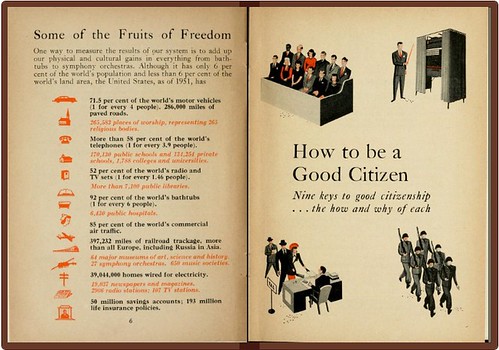
It starts with an initiative by the American Heritage Foundation in 1947, which results in the booklet Good Citizen: The Rights and Duties of an American, a conference, and the Freedom Train, an actual train that traveled across the country exhibiting “original documents that that established the nation’s democratic tradition, from the Bill of Rights to the Emancipation Proclamation.” The booklet is a wonderful artifact – I highly recommend it as a historical snapshot, and thankfully it’s available on the Internet Archive, thanks to the University of Florida’s George A. Smathers Libraries.
During this time, the American Library Association (disclaimer: my employer, although I wasn’t even born back then) “undertook its own program to promote the discussion of current issues in public libraries. This was a direction long-favored by its Executive Director Carl Milam, and, as part of its “Four Year Goals” in 1948, ALA had initiated a program called Great Issues, which urged librarians to highlight such topics as U.S.-Russian relations, civil rights, and world government in their collections and programs.”
Librarians started creating bibliographies for these topics and encouraged community organizations to form reading and discussion groups around them.
“Ruth Retzen, chair of ALA’s Adult Education Board, saw this as an opportunity for libraries to take the lead in their communities, directing their programs towards wider circulation of pertinent information: ‘Let us make our libraries active community centers for the spread of reliable information on all sides of this vital issue and for the encouragement of free discussion and action.’ “
Unfortunately, none of these efforts really succeeded, and voter turnout for the 1948 election was “surprisingly low.” To celebrate its 75th anniversary in 1951, ALA changed direction and used a $150,000 grant from the Ford Foundation to help libraries implement reading and discussion groups themselves. [Ironically, “this nationwide adult education program began in the fall of 1951 just as National Library Day observance in Phliadelphia on October 4 effectively concluded the seventy-fifth anniversary celebration.” All Philadelphia libraries are currently set to close on October 2, 2009, unless the Pennsylvania Legislature acts to save them.]
As ALA began to ramp up its program, the AHF continued to work on increasing voter turnout for the 1952 election. The folks behind the AHF program realized that guilting people into voting wasn’t working (and wasn’t likely to start working anytime soon), so they also changed direction to simply “provide adequate information and materials to implement the will of the people.” An enhanced focus on civic and nonprofit organizations brought ALA and libraries into the effort as the central source citizens could go to in order to find unbiased information. ALA agreed, in part because this meant the AHF and other organizations would promote this new role and encourage their members to seek out libraries specifically for unbiased information that could then be used to register local voters. According to Preers, this is also when libraries take on the mantle of library adult education, another new role.
It truly is a thought-provoking article (there’s a lot more to it, so you really should read the whole thing), and it highlights one of the themes that’s resonated with me personally during the last 12-18 months, that when we talk about how the library “used to be,” we have to be very specific about which era we’re referring to. As I’ve noted in the past about gaming, children’s services are a relatively recent addition to libraries, as are fiction, multimedia, and even public access (see my brief post about D. W. Krummel’s The Seven Stages of Librarianship for more about this).
More importantly, it helps show how proactive civic engagement is not a new role for 21st century libraries. We’ve done this before – successfully – and we can do it again – successfully – if we focus on specific areas. For example, studies show that gaming in libraries could include civic engagement experiences. I’m also interested in the “Great Issues” program to offer the library as a portal to civic discourse around many of the “great” issues that aren’t easily accessible to the average person. Privacy, digital identity, online reputation, media literacies, transparent government… there’s a wide range of topics that need addressing.
The question is can librarians (and not just public librarians) still provide this type of service? I question if there’s anyone else who can.
The article’s author is Jean L. Preer (not Preers).
Comment by Elsa Kramer — September 17, 2009 @ 7:05 pm
What a great find, Jenny! I’m going to share this with my colleagues and post this on Twitter. :-) I’ve been brainstorming lately about how to get my patrons and colleagues involved with civic engagement activities at our library. For starters, I’m going to do a workshop with the Reference Dept. on basic civic reference skills (finding basic info using certain local/state/federal government sources) and want to bring the workshop to the public library in town too! I’ll keep you posted. I’ll ask the public librarians what they are doing with gaming too and refer them to your Library Technology Report on Gaming and Civic Engagement!
Comment by Rebecca Blakeley — September 19, 2009 @ 9:15 pm
Keep us posted on your progress, Rebecca! :-)
Comment by jenny — September 20, 2009 @ 9:09 pm